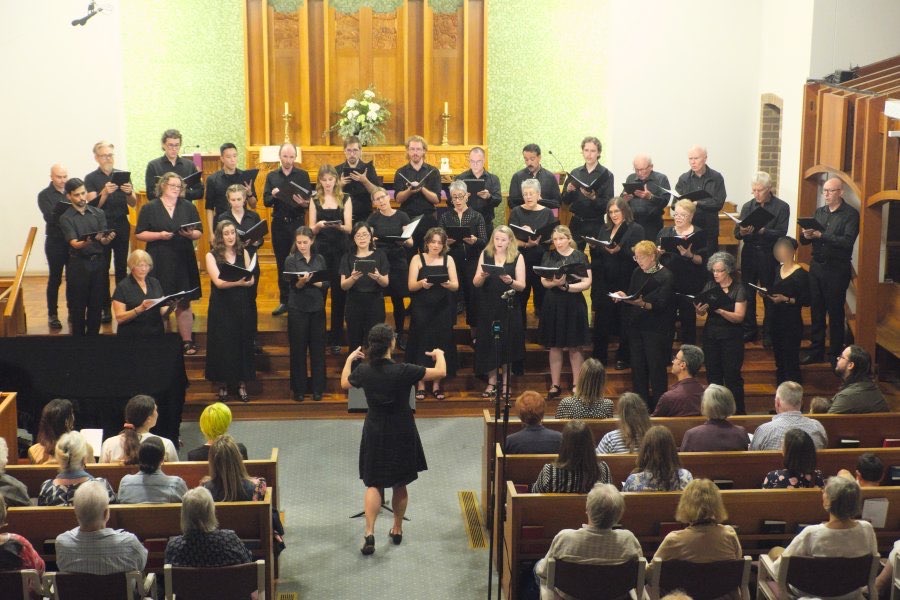
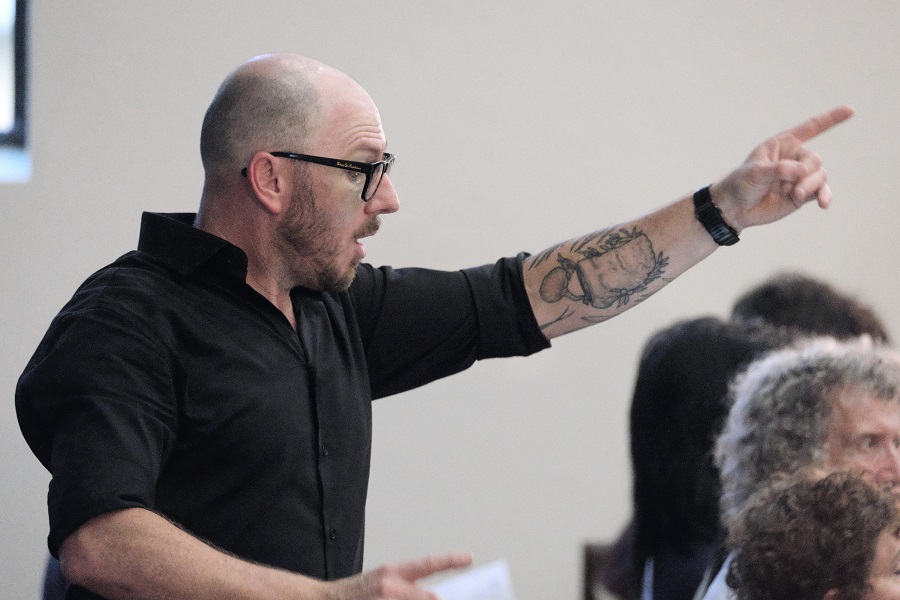
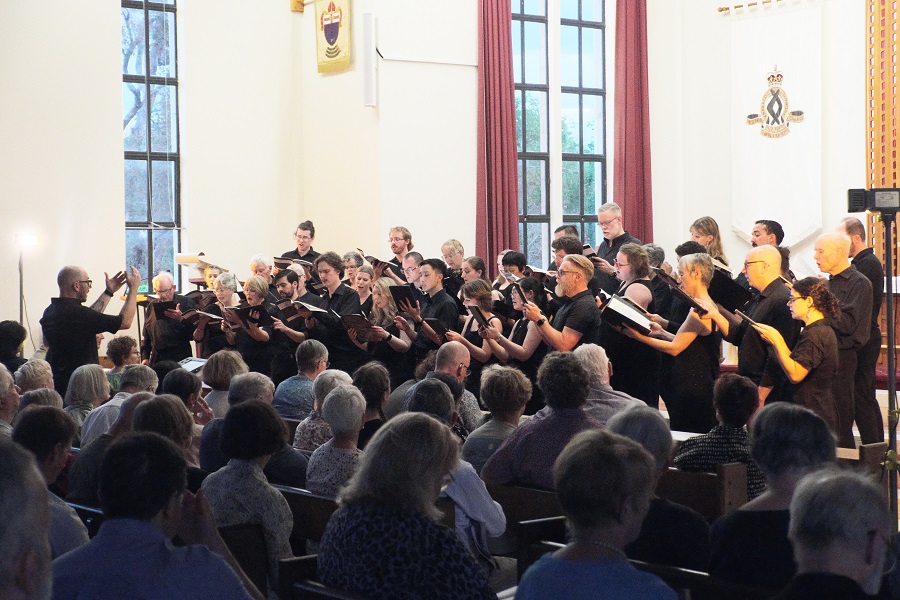
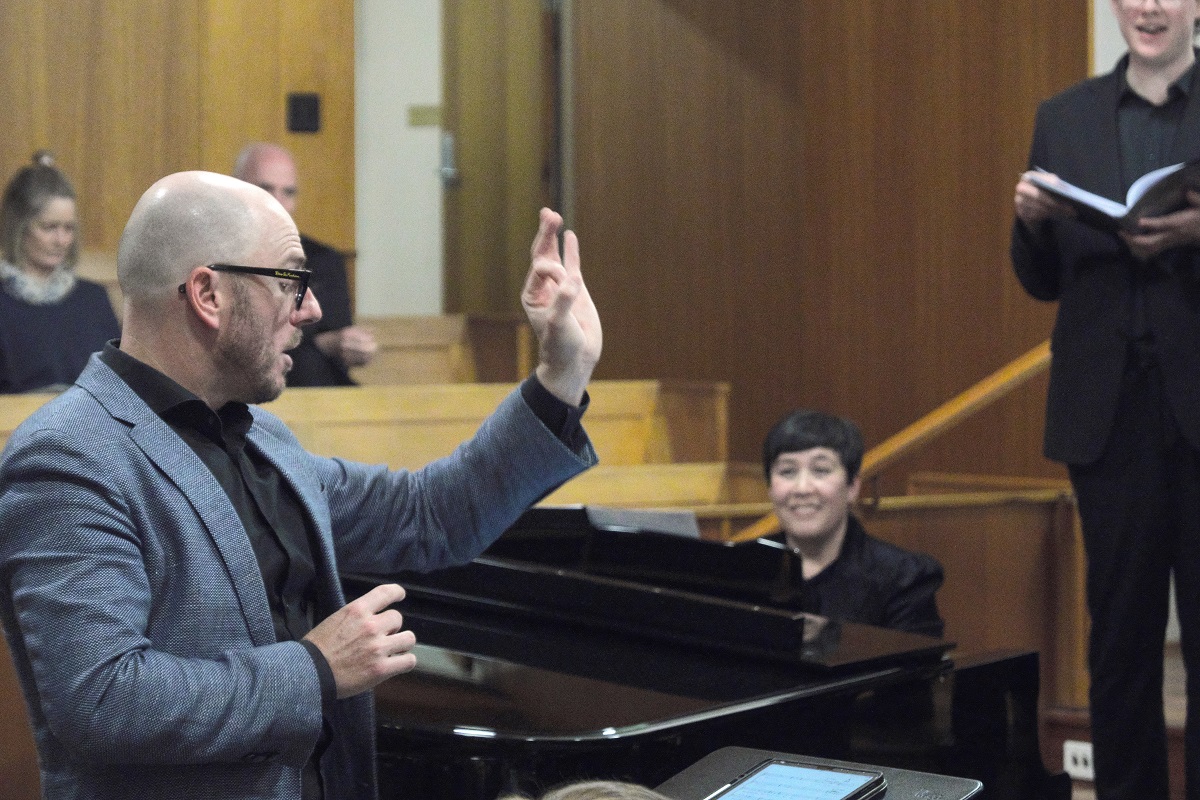
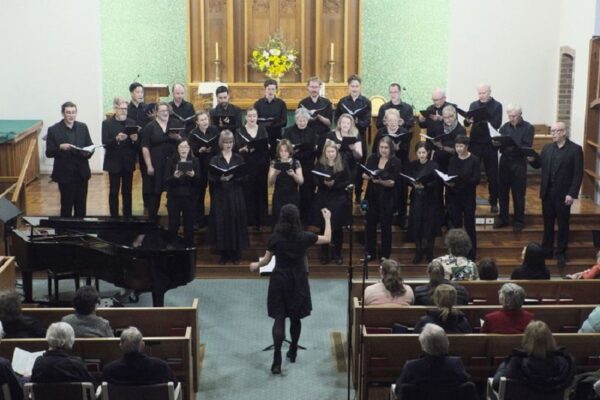
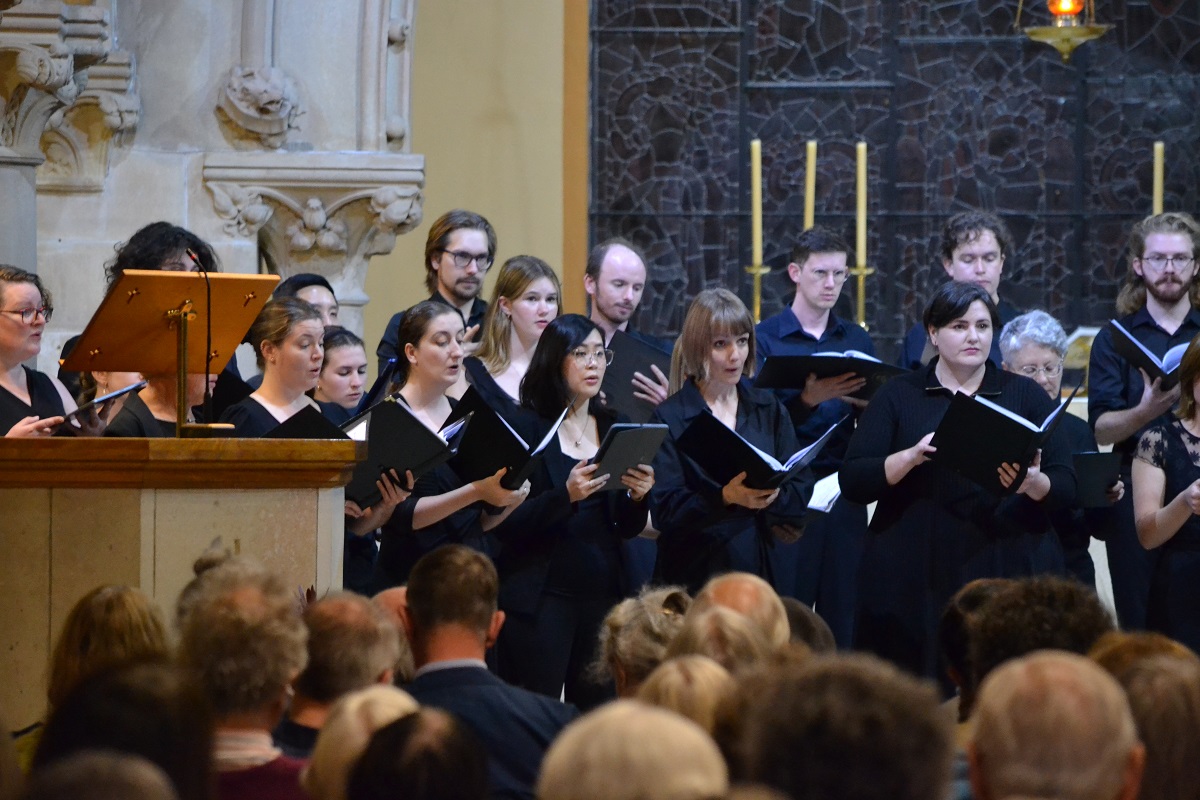
Dan Walker conducts Oriana Chorale and Apeiron Baroque. Photo: Dalice Trosthttps://citynews.com.au/2026/time-travelling-music-of-passion-and-warfare/Music / Guerrieri et Amorosi, Oriana Chorale and Apeiron Baroque, directed by Dan Walker. At Wesley Uniting Church, Forrest, July 26. Reviewed by LEN POWER.
Passion and warfare were the focus of this concert through the works of two 17th century composers, Claudio Monteverdi and Barbara Strozzi.
Monteverdi, of course, is very well-known compared to Strozzi, but she was the most prolific composer of printed secular vocal music in 17th century Venice. That was an extraordinary achievement for a woman in that era.
The Monteverdi works played and sung were from his Eighth Book of Madrigals published in 1638 when he was 70. The selection of Strozzi’s works was from her First Book of Madrigals, Opus 1, published when she was just 25.
Joined by early music specialists, Apeiron Baroque, the Oriana Chorale directed by Dan Walker presented a concert that captured the emotional range of the human condition of the time.
The concert began with the Monteverdi’s Let others sing of Cupid. This exciting work with its fiery passion and talk of war was followed by Strozzi’s The Nightingale, a sensitive work with a theme of underlying anger and hurt.
With titles such as Harmful silence, Prayer to Love and The Quarrel of the five senses (Strozzi) and I’m on fire, ablaze, Now that heaven and earth and Let others sing of Mars (Monteverdi), it was an exciting concert full of emotion and drama.
The choir gave each work a highly polished and pleasing performance. There were solo moments in the works that showcased the considerable skill of individual choir members.
Apeiron Baroque, led by John Ma, violin, provided a fine accompaniment for the choir and also played two instrumental works by Vitali and Scarlatti.
The concert provided a time-travelling opportunity to experience composers’ views of passion and warfare at a time of extraordinary music making.
Music / Uprisings, The Oriana Chorale. At Anzac Memorial Chapel Duntroon, April 12. Reviewed by MICHAEL WILSON.
The excitement in this brilliantly-executed concert by the Oriana Chorale was not in any individual piece, but in the fascinating, uplifting and courageous program itself.
Director Dan Walker assembled a collection of eight wildly contrasting works, united by a theme of uprisings generated by political turmoil and social movements. In our somewhat battered and dishevelled world, on the day of Hungary’s historic elections, challenging orthodoxy and celebrating people-power felt appropriate.
Normally, a choir might start a concert with an easier piece to settle in. Not so here. Urgency, the first of three Carols After a Plague by American composer (and anti-racism activist) Shara Nova, had a stunning, controlled, atonal beginning, with the choir showing superb vocal control and blending qualities at very low volume. Tone Policing presented a clever riff on the Christmas carol Silent Night.
Hugo Distler’s Ich wollt, das ich daheime wär (I wish that I were home) began in an almost medieval tonality and form, the choir singing with gentle, delicate phrasing towards lovely cadences. Again, a tricky but superbly executed soprano solo (Jade McFaul) helped finish this melancholy piece: the narrator wishing to leave the earth for a heavenly home.
A selection of four songs from texts by revolutionary poets by Dmitri Shostakovich showed the composer in his enigmatic wrestle with the approval of the Soviet state. In Take Heart Friend, We’re Marching Onward (poem by Leonid Radin), patriotic zeal is self-evident, while other songs were more reflective and bittersweet. Sung very convincingly in Russian, these songs showed off the considerable strength, richness and colour of Oriana’s male voices.
Amanda Feery’s The Very Air Tastes Different, written in celebration of Ireland’s referendum on same-sex marriage, again showcased the men: tenors in percussive vocalisations and high falsetto singing against more serene phrases from the basses. The final conclusive statement “all changed” hung confidently in the air.
In a concert of highlights, the final three works were all arresting. Joseph Twist’s How Shall We Sing in a Strange Land? melds Oodgeroo Noonuccal’s A Song of Hope with Psalm 137 to ask how a people finally liberated from oppression should now look to God and a new Dreamtime. Joshua Dunne’s caressing baritone solo sounded over the athletic development of difficult chords, slow slides and half-tone intervals from the choir.
Dan Walker’s Rebel Blood (sung by the women to words by Andrea Aguilar Ferro about the demonisation of menstruation) included surging crescendos and pull-backs, and a glittering finish on an unconventional but somehow satisfying chord. The Perfect Chord by Oriana’s 2026 Emerging Composer in Residence Sebastian Allen, was a brilliant finale. Gesturing to music’s ability to uplift in adversity – and celebrate diversity – this song felt like a signature number from a musical, including soprano solo and spoken phrases.
This thoroughly absorbing performance was one that will last long in the memory, both for its innovation and for its highly-polished delicacy and precision.
Music / Colours of Earth, The Oriana Chorale. At Wesley Uniting Church, December 6. Reviewed by GRAHAM McDONALD.
It is wonderfully refreshing to attend a vocal concert in December with absolutely no acknowledgement that Christmas is but a few weeks away.
Oriana’s final performance of the year was instead themed around rocks and earth and such things. It was presented in partnership with the Canberra Lapidary Club who displayed various rocks and minerals which were referenced in the music performed.
They sang four works, three by Australian composers, in an hour-long concert of remarkable intensity. All four were full of big harmonic structures, complex chords and shifting rhythms which challenged the choir occasionally. The choir was joined by percussionists Veronica Bailey and Louis Sharpe who added another layer to the sound
The first work was Desert Sea by Luke Byrne. The text describes Kati Thanda/Lake Eyre in three verses compiled from the writings of explorer Charles Sturt. The music is big, with a lot going on, including a bridging section between the middle last verses utilising bird calls which were gradually subsumed by wordless music.
The second work was Lost Leaves by Aija Draguns, Oriana’s Emerging Composer in Residence this year. This is a most admirable program to give a choral composer starting out the opportunity to work with the choir. It included some attractive melodic ideas and finished with a great last chord.
The major work of the concert was Ochre by American composer Caroline Shaw. This piece is in seven sections, all named after particular minerals and can only be described as stunning. The program notes mention that Shaw sees/hears choral voices as “the original synthesiser” and Oriana musical director Dan Walker talked about the choir as an instrument in his introduction.
This was music which could only be performed by a choir, using the timbres and tonalities of human voices. It could possibly be recreated with a bank of carefully programmed electronic synthesisers, but why would you bother?
Each of the seven sections was distinctly different. A couple were just wordless sounds, the others fragmentary texts with some hint of minerality but which mostly were there as carriers of particular vocal effects. This was a memorable musical triumph for Walker and the choir.
The concert finished with a setting by Dan Walker of a Judith Wright poem To a Child. This was in three sections, again with dense and complex harmonies, but resolved very nicely to finish a very satisfying concert.
Music / Musica Domestica, Oriana Chorale. At The Street Theatre 3, June 28. Reviewed by HELEN MUSA.
Subtitled A Musical Diary of a Remote Worker in 13 Chapters, this unusual program of choral music was devised by Canberra composer Sally Whitwell and performed under the baton of Dan Walker by an invigorated, youthful-looking Oriana Chorale.
A musical response by Whitwell to her perception that choral concerts were becoming a bit too “Samey? Distant? Unrelatable?” she created a 21st-century song cycle inspired by the covid lockdown, which traces a day in the life of a busy, independent, creative person much like herself.
Divided into 13 sections, it begins at 7am in the kitchen with Whitwell’s own composition, Caffeine Kick – Round One. Two more follow.
After entering Street Three yawning, the chorus quickly engages with the words, depicting the coffee grounds going round and round. Then the caffeine hits and the music takes off.
By 8am it’s time to head to The Bathroom for the solemn, ritualistic treatment of a shower in Michael Nyman’s Miserere, based on Psalm 55, before a 9am date in the study with Samuel Barber’s famous The Monk and His Cat. The affable Whitwell tells us about her own cat (one of four), Lucky, a keen participant in the working day, but the enunciation of the Barber was not quite clear enough to hear all the words.
Dan Walker conducts the Oriana Chorale. Photo: Matthew Teh
Back in the kitchen at 11am for another Caffeine Kick, things pick up place ready for an 11.30am session in the study. Here Whitwell reveals her deep hatred of “grammar Nazis”, before the choir happily drops the F-bomb as they perform Oxford Comma-Vampire Weekend, arranged by Patrick Baker. This was surely a first for Oriana.
It’s 12.30pm in the kitchen where the choir heads for the chopping board to perform Eat Your Vegetables by John Muehleisen. This involves vocalised sounds of slicing and chopping and an ode to the humble swede, a vegetable known in North America as the rutabaga.
By 1.30pm it’s time for the concert’s commissioned composition, One More Email: A Tragedy by Aija Draguns. Beginning softly with recurring words such as sending, pending, spinning, the female voices rise over the male drone to conjure up the endless waiting all email users have experienced as they see the “wheel of doom” rotating on their screens. This was a complex piece, beautifully performed.
After another Caffeine Kick, it’s housework time, seen in Three Ways To Vacuum Your House by Stephen Hatfield, performed by the female voices only in three movements. The first part included some delightful Indian-inspired, rhythmic counting, the second a little touch of Brazil while the final part had a traditional Scottish feel.
A blokier note was struck at 5pm session, when the hearty male choristers, down in The Cellar, sing Rounds and Catches On Drinking, attributed to Henry Purcell before the women descend to The Cellar for Whitwell’s own arrangement of the Christmassy Gloucester Wassail, sung in parts.
In the Dining Room at 7pm, members of the male chorus adopted fake Maurice Chevalier accents to introduce Be Our Guest by Alan Menken from the musical, Beauty and The Beast. This began in happy unison, but broke into parts in a very pleasing arrangement.
At 8pm in the Living Room it was time for Sally Whitwell‘s own composition, The Great Pandemic Book Club, a reference to covid lockdown online book clubs and the commissioning of humming choruses for choir-starved singers during the pandemic.
This altogether original concert finished with a beautiful Eric Whitacre song, Sleep, in four-part harmony.
The composer has said that he wanted to create music that was “warm and lush, like a feather bed”. The quiet beauty of this conclusion, superbly sung and delicately conducted by Walker, shows that he was on the right track.
Instead of a spectacular, artistic director Eugene Ughetti programmed a collection of mostly short works showcasing very contemporary Finnish and Australian music. Photo: Peter Hislop
Canberra International Music Festival / Finlandia, festival finale. At Snow Concert Hall, May 4. Reviewed by MICHAEL WILSON.
Whereas the festival’s opening concert introduced festival themes of liberté and the celebration of music from Finland and Eastern Europe, the finale – titled for Jean Sibelius’ Finlandia – was a reflection.
Instead of a spectacular, artistic director Eugene Ughetti programmed a collection of mostly short works showcasing very contemporary Finnish and Australian music.
Involving many of the musicians who had performed over the five-day program, a final tribute to First Nations music felt right.
Opening with three works by Kaija Saariaho (voted the world’s greatest living composer by her peers in BBC Music Magazine in 2019), the audience was treated to improvisations by solo strings, percussion and voice, and recorded soundscape backdrop.
Oriana Chorale and Kompactus Youth Choir then performed her Tag des Jars, with discordant harmonies and spoken words and a whispered entreaty to finish. The third movement from Saariaho’s Cloud Trio for strings featured an intriguing technique which prevented the strings vibrating, creating an incredibly soft but gritty sound effect.
Following the wonderful Cantabile by Helvi Leiviskä – a song-like duet performed by Paavali Jumppanen on piano and Tipi Valve on his magnificently warm and resonant cello – a celebration of Finland’s most famous son, Sibelius.
The scherzo and moderato from his Piano Quintet in G, flawlessly performed, flowed on to a celebration of Sibelius’ hymn Finlandia.
It built from solo cello melody up to massed choir, and then a tremendously effective modern take by Erkki Veltheim (also on violin) comprising sound installation (bird calls, raindrops, wind) and instrumental improvisation where the Finlandia theme peeped through subtly but brilliantly.
The second half opened with yet another marvellous composition for choir by festival artist-in-residence Olivia Davies: women’s voices singing long portamentos (slides) in both directions over the humming of the men, then spoken words from Thuy On’s title poem Murmuration.
Mark Atkins on the yidaki (Arnhem Land didgeridoo). Photo: Peter Hislop
After the festival opening concert’s heartbreakingly brief introduction to Mark Atkins on the yidaki (Arnhem Land didgeridoo), we got a satisfying serve here.
First with a short improvisation, and then as the anchor for another Davies piece, Enfold, Atkins amazed with the breadth of sound and effects he pulled from his instrument, joined in series by two bagpipes and a single chanter, finishing simply with droned notes in arpeggio.
Another highlight was Outi Tarkiainen’s mesmeric Without a Trace for solo piano, a tribute to Sámi (First Nations of Finland, Norway and Sweden) reindeer herders.
Surely the hero of the festival, Jumppanen used every part of the piano (played, strings plucked, strings held using the keys as percussion, beating inside the soundbox) and his voice, uttering words from a Sámi poem.
The finale was a festival commission by Warrimay composer Nicole Smede, comprising six choirs. Photo: Peter Hislop
The finale was a festival commission by Warrimay composer Nicole Smede, comprising six choirs, singing in language, with the three indigenous choirs also performing percussion on clapsticks, eucalyptus boughs, stamping and clapped rhythms, underpinned by the yidaki.
Melody lines sung from the stage were then repeated by choirs in the balconies of the Snow Concert Hall, with rising and descending triplet patterns and syncopations.
A celebratory cheer was a fitting end to a most engaging, educative and high-quality festival.
Olivia Swift conducts The Oriana Chorale. Photo: Peter Hislop
Music / We Were Not Ready, Music of Loss, of Grief and of Healing, The Oriana Chorale. At Wesley Uniting Church, Forrest, March 21. Reviewed by ALANNA MACLEAN.
This splendidly compact Oriana Chorale concert pulled together an eclectic range of composers and pieces presented with precision and energy by a band of highly skilled musicians conducted by director Dan Walker.
Deaths and losses and passage beyond the initial grief figured repeatedly so it was enough that the intense evening ran just over an hour and it was fitting that there be no interval.
The evening began with English composer Thomas Weelkes’ measured and feeling 17th century setting When David Heard, which might well commemorate the death in 1612 of Henry, Prince of Wales, setting Absalom’s death against that of the immensely promising prince.
Later a solemn piece of the same name by American composer Eric Whitacre brought that powerful reference back using the same spare and resonant biblical text.
Walker handed over to Olivia Swift to conduct The Soldier’s Grave, her composition based on a poem about an American Civil War soldier’s resting place, a sombre meditation on how little is known about some dead. Not all are the sons of kings.
She followed that with a moving performance of Paola Prestini’s atmospheric Fratres, which echoes the sounds that might go on in a church immersed in the ceremony of communion and remembrance.
Walker resumed the podium for the rest of the briskly run evening with Butterfly, a short piece by Finnish composer Mia Makaroff, short and sharp as the life of humans.
It was almost a relief to be settled next into the familiar measured music of Monteverdi’s sestina Lagrime d’amante al sepolcro dell’amata before moving back to When David Heard, this time in a version by American composer Eric Whitacre, responding strongly and dramatically to the death of a friend’s son. The choir were more than up for the technical challenges of this longish piece.
The death of a grandfather and a Latvian good night song for children inspired and infused Ella Macens’ disturbingly named We Were Not Ready.
The program was rounded out with Dan Walker’s arrangement of an earthy piece from America’s unaccompanied “sacred harp” tradition, All is Well. In the face of inevitable death what else can really be said?
The Oriana Chorale left us wanting more but knew when less was enough.
Daunting wall of sound any Baltic choir could have been proud of
Oriana Chorale director Dan Walker. Photo: Peter Hislop
Music / Rachmaninoff Vespers: All-Night Vigil, Oriana Chorale, directed by Dan Walker. At Anzac Memorial Chapel Duntroon, November 24. Reviewed by SAM WILSON.
As a celebrated a cappella choir prepared to take on ambitious works, Oriana Chorale drew a large crowd to the Duntroon Chapel for its rendition of Sergei Rachmaninoff’s All-Night Vigil.
Conducted and directed by the Canberra composer, conductor, performer and vocal specialist Dan Walker, Oriana Chorale presents three major concerts each year, with repertoire ranging from the classics to Australian contemporary composers. For the All-Night Vigil, the choir was joined by soloists Andrei Laptev (tenor), Andrew Fysh (bass) and Maartje Sevenster (alto).
A staple of Russian liturgical music and one of the composer’s most praised works, All-Night Vigil is a 15-movement a cappella piece set to texts taken from the Russian Orthodox vigil ceremony, consisting of Vespers (1-6), Matins (7-11), Lauds (12), and Prime (13-15).
Despite being in the general tradition of Russian Orthodox music in terms of style and even musical themes, All-Night Vespers is a complex and challenging piece to perform. Although written for four-part SATB choir, Rachmaninoff frequently breaks into five, six, and eight-part harmony, with the choir even breaking into 11 parts during the seventh movement. Oriana Chorale handled this challenge well, while maintaining a full-bodied and balanced sound.
One secret to achieving this balance and unity is that Dan Walker has his choir mixed, not organised in vocal parts. This forces singers to tune in to what all other parts are doing, and means that each chorister needs to know their own line intimately. The effect was a sound that was beautifully balanced, rich and blended in the quite precise acoustic of the Duntroon Chapel.
Rachmaninoff All Night Vigil. Photo: Peter Hislop
Singing convincingly in the Russian language is a massive challenge if Russian is not your native tongue, but Oriana had clearly been coached effectively.
Musically, the choir was impressively self-sufficient, beginning each movement confidently after only an intoned note sung by Walker after striking a tuning fork on his skull. Along with Walkers’s fluid and unfussy conducting style, this gave the performance an elemental, stripped back feeling.
Walker was particularly good at moving the tempo along, shaping phrases, and achieving magical pianississimo endings that simply faded to nothing. Likewise, when the score required fortefortissimo, the choir produced a daunting wall of sound, which any serious Russian or Baltic choir could have been proud of.
All the soloists executed their lines with accomplishment, but Andrei Laptev, whose musical journey has been in the Russian Orthodox tradition, was especially effective. Bell-like intonation, a restrained use of vibrato, and an affinity with the language and the text all made for an utterly authentic and confident performance.
The All-Night Vigil is a big sing, and requires lots of concentration. Oriana’s performance was just on an hour, and by the end some of the entries and endings were perhaps a little less crisp than at the beginning. Russian choirs are renowned for being able to shake a church’s foundations with low Ds and Cs in the bass line, and Oriana’s basses couldn’t quite achieve this effect (although the notes were there).
This was a very rare opportunity to hear an iconic work performed by a technically very able, well-coached and very musical choir.
The Oriana Chorale’s Dan Walker and Sally Whitwell. Photo: Peter Hislop
Music / Flight, the Oriana Chorale. At Wesley Uniting Church, July 27. Reviewed by GRAHAM McDONALD.
For this concert, themed around the idea of flight and flying, the Oriana Chorale presented an hour and a quarter or so of, with one exception, contemporary vocal music full of surprises and delights.
The exception was a 16th century Italian madrigal which fitted seamlessly into the rest of the program being sung immediately before a work by American choral composer Eric Whitacre, Leonardo Dreams of his Flying Machine, which references renaissance vocal music.
Olivia Swift conducting Oriana. Photo: Peter Hislop
The first half of the concert was the choir by itself, with the opening work Butterflies, by Australian composer Mathew Orlovich, a delightful work of wonderfully complex rhymes and harmonies constantly shifting with a marvellous last chord. This was skilfully conducted by Olivia Swift, otherwise an alto in the choir.
For the second half of the performance the choir was joined by pianist and composer Sally Whitwell where they sang two of her works, with Whitwell accompanying on piano. She also accompanied English composer Kerry Andrew’s Rhymes and Charms for Fly-Away Things which blended nursery rhymes and English folk song into the vocal scoring.
When the choir left for a short break after the first half, Whitwell introduced herself and performed a short, as yet un-named, work, composed that very morning (as she does each day) This cleverly morphed into the introduction to her A Hundred Thousand Birds with the singers entering the hall from the back and side chirping and whistling random bird calls in an excellent piece of musical theatre.
Whitwell has a skill in writing piano accompaniments which support the often quite complex vocal lines without interfering with them, yet adding to the overall effect. This was also apparent in her second work Flying, where anthemic vocal lines led to one silly line of text.
The choir rounded out the evening with Rocket Man by Elton John in an arrangement that both captured the original feel yet turned it into an interesting choral work, with Whitwell channelling Elton on the piano and a clarinet obligato from a moonlighting soprano. A fine way to end a most satisfying concert.
Chorale sings religious music with a sense of enjoyment
The Oriana Chorale. Photo Matthew Teh
Music / Prayers and Lamentations, The Oriana Chorale. At All Saints, Ainslie, April 13. Reviewed by GRAHAM McDONALD.
It has been a year or two since I last heard The Oriana Chorale and it was interesting to see a generational shift in the choir’s membership. It is now at least half singers in their 20s and 30s (rather than 50s and 60s) with a real sense of enjoyment in the music they are creating.
This was a concert of essentially religious music over a span of 400 years, with the first half of the concert covering both ends of that time range and the second half focusing on the first half of last century.
The first section of the concert was Thomas Tallis’ settings of The Lamentations of Jeremiah, written in the mid 16th century, separated by a motet by English composer Roxanna Panufik written in 1997. The two Tallis settings were sung beautifully, with a fine balance to the choir. The Panufik motet was sung at the same pace, but full of unexpected harmonies, rather as if the composer had added another five parts of utterly different music to a more standard choral work. Notable was a strong and confidant solo from soprano Jade McFaul.
Tallis’ sacred music is always uplifting and rejuvenating and the clever addition of the modern work was clever and inspired programming by musical director Dan Walker.
The second half of the concert shifted to the early 20th century with the music of Igor Stravinsky and Lili Boulanger. Stravinsky’s Symphony of Psalms is a setting of three psalms for orchestra and choir from 1930, using a condensed instrumental backing of piano, violin and clarinet done by Melbourne musician Stefan Cassomenos. This was interesting and unusual in the scoring with the three sections all building in interest throughout.
The final work was the setting of a Buddhist prayer written in 1917 by French composer Lili Boulanger with a curious and, for the time, unusual “oriental” flavour using non-Western scales and harmonies. This featured a solo from tenor Cody Christopher and an orchestral score condensed by Walker to the three instruments. A very effective and intriguing work to finish a fine concert.